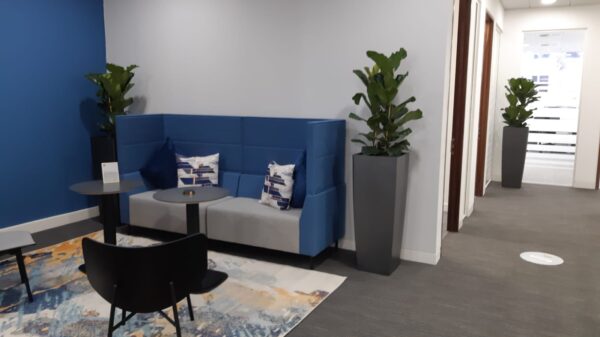
Walk into a space filled with plants and sunlight, and something changes. Your shoulders drop. Your breathing slows. You feel more at ease.
That reaction is not new. It’s part of a story that began long before the term biophilia was ever written down.
Where It All Began
The word biophilia means “love of life.” It first appeared in the 1960s when psychologist Erich Fromm used it to describe a deep affection for living things. He saw it as the opposite of disconnection and greed.
Two decades later, Edward O. Wilson, a Harvard biologist, gave the word new meaning. In his 1984 book Biophilia, he suggested that humans are born with an instinct to connect with nature. He argued that our need for greenery, daylight, and fresh air is not a design choice but a biological drive shaped over millions of years.
That idea challenged how people saw the built world. Wilson believed that modern life had taken us too far from what made us feel human.
Before Cities, There Were Landscapes
For most of human history, people lived outside. We learned to read the land, listen to birds, notice shade and shelter. A grove of trees meant food and safety. Open plains meant risk but also opportunity.
Over time, our brains adapted. We came to feel calm near water and uneasy in dark or airless places. Even today, studies show that natural scenes lower our stress levels, improve focus, and boost our mood.
This is why a park can feel more restorative than a gym, and why offices with daylight are linked to higher job satisfaction. The connection runs deep.
The Break from Nature
The Industrial Revolution brought huge progress but also distance. Cities grew taller and denser. Work moved indoors. Light came from bulbs, not the sun.
By the mid-20th century, people began to notice the cost. Concrete buildings without texture or greenery felt cold and tiring. Research showed that such spaces could increase stress, fatigue, and illness.
Architects started asking: what happens when we remove nature from daily life? And more importantly, how can we bring it back?
Turning Science into Design
In the 1990s, researchers like Stephen Kellert and Judith Heerwagen began exploring how Wilson’s theory could guide architecture. They identified three main ways to reconnect people with nature through design:
- Direct connection – using plants, water, sunlight, and fresh air.
- Indirect connection – using natural materials, colours, and forms.
- Spatial experience – creating a sense of prospect, refuge, and balance in how we move through space.
These ideas gave designers a framework to make buildings that felt alive.
Since then, countless studies have supported their approach. Offices with greenery report higher productivity and lower absenteeism. Hospitals with views of nature see faster recovery times. Classrooms with natural light improve focus and learning outcomes.
Challenges Along the Way
Not everyone agrees on how to define or measure biophilia. Some argue that adding a few plants is not enough, and that true biophilic design must start with structure, not decoration. Others point out that it’s easier to apply in wealthy spaces than in crowded cities or affordable housing.
There are also practical questions. Who maintains living walls once they are installed? How do we design for nature in small urban plots? And how do we measure wellbeing without reducing it to numbers?
These questions keep the field honest. They stop biophilia from turning into a passing trend.
The Modern Landscape
Today, biophilic design is everywhere. Companies use it to create healthier workplaces. Hospitals use it to reduce stress for patients. Schools use it to support attention and calm.
At its best, biophilia is not just about beauty. It’s about respect for the systems that keep us alive. It reminds us that good design should not fight against nature but work with it.
Looking Ahead
As technology grows and cities expand, our need for connection with nature becomes more urgent. Biophilia gives us a language to rebuild that bond.
It’s not about filling every room with plants. It’s about asking how a space makes people feel. Does it breathe? Does it offer balance, calm, and life?
When those answers are yes, we are not just designing better buildings. We are designing a better way to live.