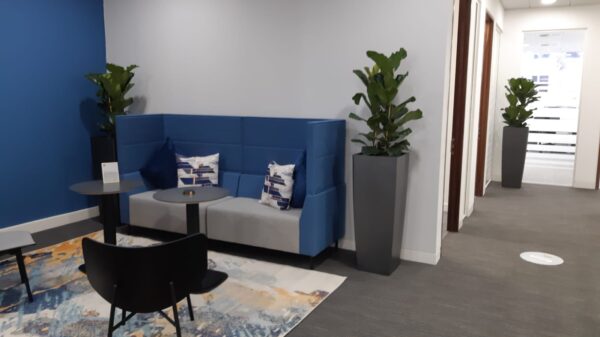
Every office or building has them, the corners that never seem to catch the light.
A north-facing room, a hallway, or that desk tucked behind a partition.
They’re often the places that feel the least alive. Yet they’re also the spaces where the right plant can make the biggest difference.
Low-light areas don’t have to look dull. With the right mix of species, you can create small ecosystems that thrive quietly, adding texture, movement, and calm where natural light is scarce.
Understanding What “Low Light” Really Means
Many people assume low light means total darkness, but that’s not the case.
Plants need some level of natural or artificial light to photosynthesise, to turn energy into growth.
In interior design, low light usually means indirect sunlight or areas several metres away from a window. These are spaces where you could read comfortably without a lamp during the day, but where direct sun rarely falls.
Artificial light can also make a difference. Fluorescent and LED lighting, especially those with a full-spectrum range, can support plant growth if used consistently.
The Quiet Heroes of the Shade
Below are five reliable performers that don’t just survive in low light but bring presence, form, and texture to any workspace or interior.
- Zamioculcas Zamiifolia (ZZ Plant)
Often called the indestructible plant, the ZZ plant stores water in its thick stems and tolerates neglect better than almost anything else. It has glossy, dark green leaves that reflect light beautifully, giving depth to shaded corners. It prefers to dry out between waterings and rarely needs repotting.
- Sansevieria (Snake Plant or Mother-in-Law’s Tongue)
With its upright leaves and sculptural form, the snake plant is a classic for offices. It thrives in low light and only needs watering once every few weeks. Studies by NASA’s Clean Air program even linked it to better air quality by removing toxins such as benzene and formaldehyde.
- Aglaonema (Chinese Evergreen)
One of the most adaptable indoor plants, Aglaonema offers wide, patterned leaves that can brighten dark corners without needing much care. It tolerates low humidity and artificial light and comes in colours from silver-green to red-tinted varieties, adding subtle warmth to modern interiors.
- Epipremnum Aureum (Pothos or Devil’s Ivy)
Pothos is a natural choice for offices and homes because it grows easily and can be trailed, hung, or trained to climb. It keeps its deep green or variegated foliage even in dim light and helps remove airborne pollutants.
- Aspidistra Elatior (Cast Iron Plant)
As the name suggests, this plant is almost indestructible. The Victorians loved it because it survived smoky, gas-lit rooms. Today, it’s perfect for modern low-light offices, with arching, glossy leaves that lend an old-world calm.
Beyond Aesthetics: Why Plants Matter in Dim Spaces
Adding greenery isn’t only about filling visual gaps. Plants subtly change how we experience a space.
Research by the University of Exeter found that adding plants to an office can increase productivity by up to 15% and improve concentration and job satisfaction. Other studies link plant presence to lower stress levels and reduced background noise.
Even in darker areas, where growth is slower, the presence of life shifts perception. It softens the geometry of walls and ceilings, draws the eye upward, and gives the mind a place to rest.
Caring for Plants in Low Light
Low-light plants grow slowly, which means they need less water and fertiliser. Overwatering is the most common cause of failure. Let the soil dry slightly between waterings and rotate plants occasionally so all sides receive light.
Dust leaves monthly to help photosynthesis and keep the foliage glossy. For areas without any natural light, consider adding a simple LED grow bulb on a timer.
A Living Design Principle
There’s a quiet satisfaction in seeing a plant thrive where it shouldn’t. In many ways, that’s the essence of good design, making life possible in unlikely places.
Low-light greenery teaches patience and observation. It invites you to slow down, to notice small changes, to reconnect with living systems in the spaces where we often forget them.
Even in the darkest corner, something can grow.